


Summary – In India, divorce is governed by personal laws based on religion, such as the Hindu Marriage Act, Muslim personal law, Christian law, and others. While a marriage certificate is considered strong legal proof of a valid marriage, many couples especially those married through traditional or religious ceremonies may not have officially registered their marriage. This often raises concerns about whether they can file for divorce without such documentation.
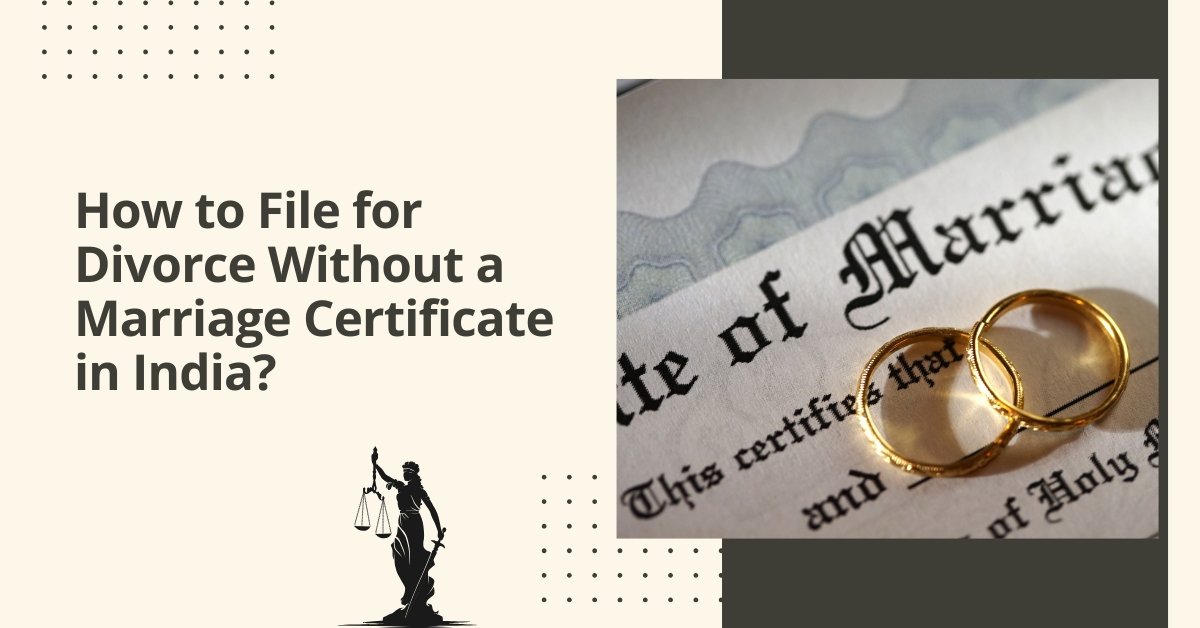
Filing for divorce in India without a marriage certificate is possible, but it requires you to rely on alternative forms of proof to establish that a valid marriage took place. While a marriage certificate is the most straightforward legal document to confirm a marital relationship, many couples especially in traditional or rural settings may not have formally registered their marriage. In such cases, Indian courts recognize other evidence like wedding photographs, invitation cards, witness statements, joint bank accounts, or proof of cohabitation to validate the marriage.
In this guide, you will learn how to handle such situations, what alternative proofs you can use, and the steps involved in filing for divorce without a marriage certificate in India.
Is a Marriage Certificate Mandatory for Divorce?
A marriage certificate is not strictly mandatory to file for divorce in India, but you must still prove that a valid marriage took place. Indian courts recognize marriages performed through customary rituals even if they were never officially registered. In the absence of a marriage certificate, the court will accept alternative evidence such as wedding photographs, invitation cards, joint bank accounts, address proofs showing cohabitation, or testimony from witnesses who attended the marriage.
However, not having a certificate can make the process slightly more complex, especially in contested cases, because the burden of proving the marriage lies on the petitioner. In mutual consent divorces, this issue is usually easier to handle if both parties acknowledge the marriage.
Alternative Proofs of Marriage Accepted by Courts
When a marriage certificate is unavailable, Indian courts do not reject a divorce petition outright. The key requirement is to show that the marriage was performed according to applicable personal laws and that both parties lived as husband and wife. Here are the alternative proofs of marriage accepted by courts in India, explained in detail:
1. Wedding Photographs & Videos
Photographs or videos of the marriage ceremony are one of the most commonly accepted forms of evidence. These visuals help demonstrate that customary rituals (like saptapadi in Hindu marriages) were actually performed. Courts consider them strong supporting evidence, especially when they clearly show the couple participating in wedding rituals.
2. Wedding Invitation Cards
Marriage invitation cards can establish that a wedding was planned and publicly announced. While not conclusive proof on their own, they support the claim that a ceremony took place and are often used alongside other documents.
3. Witness Testimony
Statements from people who attended the wedding such as family members, relatives, friends, or priests are highly valuable. Witnesses can confirm:
- The date and place of marriage
- The rituals performed
- The identity of the parties
Courts give significant importance to credible witness testimony, especially in contested cases.
4. Joint Residential Proof
Documents showing that the couple lived together as husband and wife can strengthen the claim of marriage. These may include:
- Ration card with both names
- Aadhaar cards showing the same address
- Rental agreements
- Utility bills (electricity, water, etc.)
Such records help establish cohabitation, which supports the existence of a marital relationship.
5. Joint Financial Documents
Financial records indicating a shared life are also considered:
- Joint bank accounts
- Insurance policies naming spouse as nominee
- Property documents in joint names
- Income tax returns mentioning spouse
These documents reflect a recognized marital relationship in practical life.
6. Birth Certificates of Children
If the couple has children, their birth certificates mentioning both parents’ names serve as strong supporting evidence of marriage. Courts often treat this as significant proof of a long-standing marital relationship.
7. Social Media & Digital Evidence
In modern cases, courts may consider:
- Social media posts announcing the marriage
- Photos shared publicly
- Messages or emails referring to each other as spouses
While not primary proof, digital evidence can support other documents.
8. Affidavits by the Parties
Both spouses can submit sworn affidavits confirming that they are legally married. In mutual consent divorce cases, this becomes especially important, as both parties acknowledge the marriage.
9. Religious or Community Records
In some cases, records maintained by temples, mosques, churches, or community organizations may be used to prove that a marriage ceremony was conducted.
10. Any Government Record Mentioning Spouse
Documents like:
- Passport
- Voter ID
- Pension records
- Employment records
that mention the spouse’s name can also support the existence of a marriage.
Step-by-Step Process to File Divorce Without Certificate
Step 1: Understand the Legal Validity of Your Marriage
In India, marriage registration is not compulsory under all personal laws. For example, under the Hindu Marriage Act, a marriage is considered valid if essential rituals such as saptapadi are performed. Therefore, even without a certificate, a marriage can still be legally recognized.
However, in the absence of a certificate, the burden lies on the petitioner to prove that:
- A valid marriage ceremony took place
- The couple lived together as husband and wife
Step 2: Consult an Experienced Divorce Lawyer
Seeking legal advice is essential in such cases. A family lawyer will:
- Identify the applicable personal law
- Evaluate the available evidence
- Guide you on strengthening your case
- Draft the petition properly to avoid rejection
In contested matters, the opposing party may challenge the existence of marriage, making legal expertise crucial.
Step 3: Collect Alternative Proofs of Marriage
Since there is no marriage certificate, you must rely on alternative evidence. Courts generally accept a combination of documents such as:
- Wedding photographs and videos
- Marriage invitation cards
- Witness statements (family members, priest, friends)
- Proof of cohabitation (rental agreements, utility bills, Aadhaar with same address)
- Joint financial documents (bank accounts, insurance policies)
- Birth certificates of children
- Government records mentioning spouse
The stronger and more consistent the evidence, the better your chances of success.
Step 4: Decide the Type of Divorce
You must determine whether the divorce will be:
Mutual Consent Divorce
Both parties agree to end the marriage. This process is generally faster and less complicated. The absence of a marriage certificate is less likely to create disputes if both parties acknowledge the marriage.
Contested Divorce
One spouse files against the other on specific legal grounds. In such cases, proving the marriage becomes more critical, especially if the other party denies it.
Step 5: Draft the Divorce Petition
Your lawyer will prepare the petition, which must clearly include:
- Date and place of marriage
- Details of the ceremony and rituals performed
- Names of witnesses present at the marriage
- Duration of cohabitation
- Grounds for divorce (cruelty, desertion, etc.)
- Details regarding children, maintenance, or property
The petition must be detailed enough to compensate for the absence of a marriage certificate.
Step 6: File the Petition in Family Court
The petition is filed in the appropriate family court based on jurisdiction, which may include:
- Place where the marriage occurred
- Last place where the couple lived together
- Current residence of the wife
All supporting documents and affidavits must be submitted along with the petition.
Step 7: Court Scrutiny and Admission
The court examines the petition and documents to ensure there is sufficient prima facie evidence of marriage. If the court finds the evidence inadequate, it may:
- Ask for additional documents
- Seek clarification
- Delay the admission of the case
Step 8: Notice to the Other Party
In contested divorce cases, the court issues a notice to the other spouse. They are required to appear and respond to the petition. If the other party denies the marriage, the burden of proof becomes heavier on the petitioner.
Step 9: Evidence and Examination Stage
This is the most important stage when no marriage certificate is available.
During this stage:
- Documents are formally presented as evidence
- Witnesses may be examined
- Cross-examination may take place
The court evaluates:
- Authenticity of documents
- Consistency of statements
- Credibility of witnesses
Step 10: Mediation or Counseling
Courts often refer the matter to mediation to attempt reconciliation or settlement. Issues such as maintenance, alimony, and child custody may also be discussed.
Common Challenges & How to Overcome Them
Filing for divorce without a marriage certificate can create a few practical and legal difficulties. However, most of these challenges can be managed with the right approach. Here is a simple and detailed explanation:
1. Difficulty in Proving the Marriage
Challenge:
The biggest issue is proving that a valid marriage actually took place. Without a certificate, the court cannot rely on official registration.
How to Overcome:
- Collect multiple proofs such as wedding photos, invitation cards, and videos
- Arrange witnesses like family members or the priest who conducted the marriage
- Submit documents showing you lived together (address proof, joint accounts)
The court usually accepts a combination of evidence rather than a single document.
2. Denial of Marriage by the Other Spouse
Challenge:
In contested cases, the other party may deny that the marriage ever happened to delay or avoid the case.
How to Overcome:
- Present strong and consistent evidence from different sources
- Use witness statements to support your claim
- Provide government or financial records where the spouse’s name is mentioned
Consistency across all documents is very important.
3. Lack of Proper Documentation
Challenge:
Many people do not maintain records like invitations, photos, or joint documents, especially in older marriages.
How to Overcome:
- Gather whatever is available, even if limited
- Use affidavits from both parties or witnesses
- Try to obtain duplicate records (e.g., photos from relatives, event organizers)
Even indirect proof can help when combined properly.
4. Delays in Court Proceedings
Challenge:
Cases without a marriage certificate may take longer because the court spends extra time verifying the marriage.
How to Overcome:
- Submit complete and organized documents from the beginning
- Avoid missing hearings or deadlines
- Work with a lawyer who prepares your case properly
Good preparation can significantly reduce delays.
5. Weak or Inconsistent Evidence
Challenge:
If your documents contradict each other (different dates, names, or details), the court may doubt the validity of the marriage.
How to Overcome:
- Double-check all documents before submission
- Ensure names, dates, and places match across records
- Clearly explain any differences through an affidavit
Accuracy and clarity are key.
6. Difficulty in Mutual Consent Divorce
Challenge:
Even in mutual divorce, the court still needs basic proof of marriage.
How to Overcome:
- Both spouses should submit affidavits confirming the marriage
- Provide simple supporting documents like photos or address proof
- Ensure both parties give consistent statements in court
When both parties agree, the process becomes much smoother.
7. Objections from the Court
Challenge:
The court may raise questions or ask for additional proof if it is not satisfied with the documents provided.
How to Overcome:
- Be prepared to submit additional evidence when asked
- Keep original documents ready for verification
- Follow your lawyer’s advice on responding to objections
Responding quickly and correctly helps avoid complications.
8. Emotional and Practical Stress
Challenge:
Managing legal issues without proper documents can be stressful and confusing.
How to Overcome:
- Stay organized and keep all documents in one place
- Rely on professional legal guidance
- Focus on completing each step patiently
A structured approach reduces stress and confusion.
Final Thoughts
Navigating a divorce without a marriage certificate requires a more strategic and evidence-based approach, especially when legal proof of marriage is questioned. Each step, from gathering documents to presenting your case in court, must be handled carefully to avoid delays or objections.
To ensure that your case is handled efficiently and your rights are fully protected, it is always advisable to seek guidance from the best divorce lawyer in India, who can help you navigate the legal complexities and achieve a smooth and timely resolution.
Frequently Asked Questions
- All Posts
- Child Custody
- Criminal
- Divorce
- Family
- Law
- Property